
Fermare il tempo - Vogue Italia - Articolo
Luglio 2022

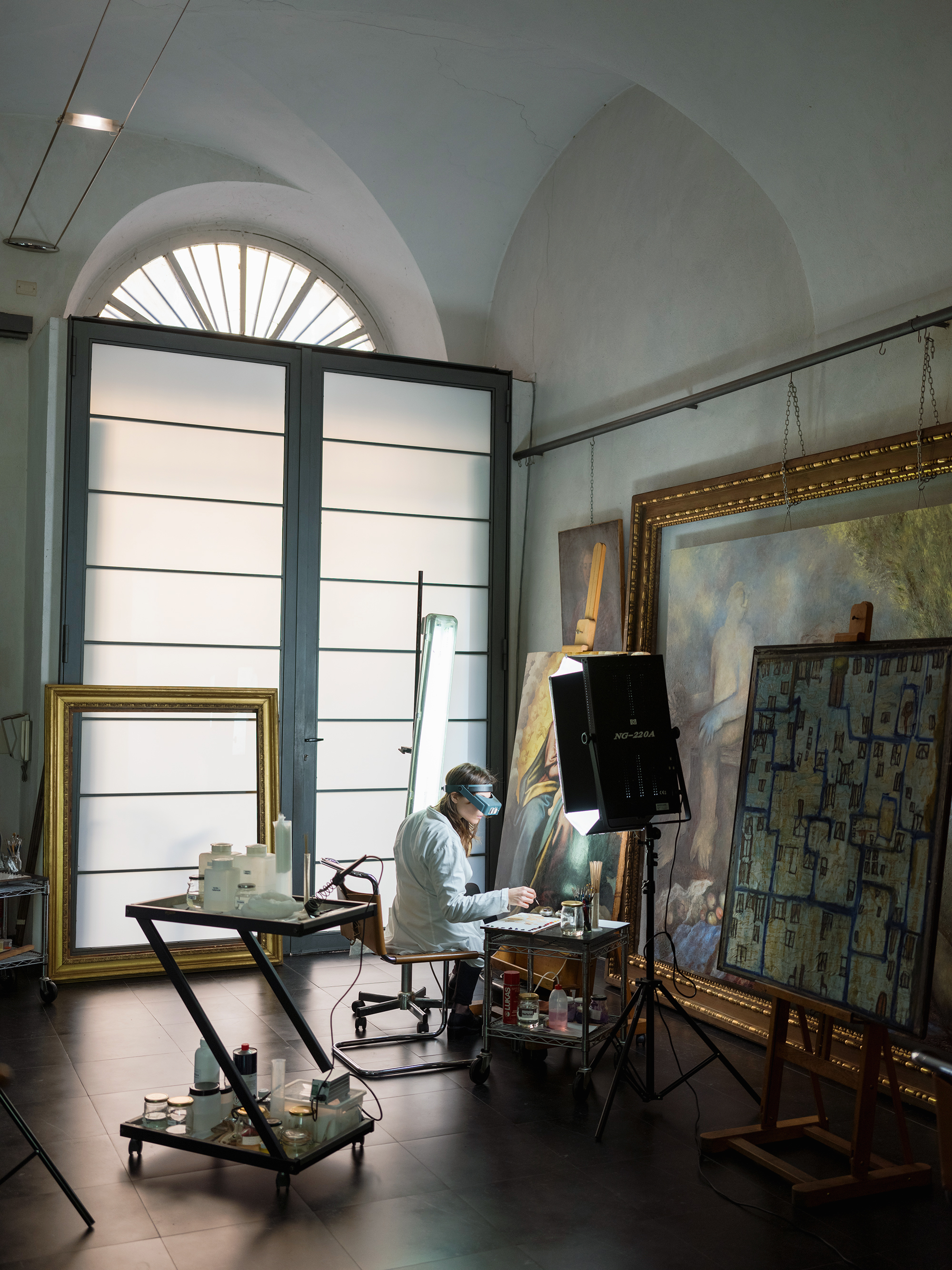
The article, written by Italia Segreta, presents restoration as a discipline in which art, science, and technology come together to restore works to their original authenticity. The inspiration comes from the words of British photographer Brett Lloyd, author of the fashion editorial set in the Merlini Storti studio, who describes the emotion of seeing hidden details of a painting re-emerge, such as a tear on the face of St Francis.

The text highlights the leading role played by Italian institutions of excellence such as the Central Institute for Restoration and the Opificio delle Pietre Dure, where interdisciplinary skills and advanced research—from lasers to 3D mapping and XRF, as well as the use of natural substances and sustainable techniques—are redefining preventive conservation. Sandra Rossi also emphasizes the importance of scientific collaborations with institutions such as the CNR and INFN to advance the study of artistic materials.

A concrete example is the restoration of Giovanni Bellini’s Madonna in Glory and Eight Saints, supported by the Venetian Heritage Foundation and led by Toto Bergamo Rossi, which promotes international partnerships to safeguard Venetian heritage.

Finally, the article recounts the success of the “restoration open to the public” project promoted by the Merlini Storti studio, tested with works such as Caravaggio’s The Conversion of Saul: an innovative way to share the conservation process and bring the public closer to the intimacy and history of masterpieces, a field that often remains secretive and inaccessible.

No items found.
No items found.
No items found.
Fermare il tempo - Vogue Italia - Articolo
Luglio 2022

The article, written by Italia Segreta, presents restoration as a discipline in which art, science, and technology come together to restore works to their original authenticity. The inspiration comes from the words of British photographer Brett Lloyd, author of the fashion editorial set in the Merlini Storti studio, who describes the emotion of seeing hidden details of a painting re-emerge, such as a tear on the face of St Francis.

The text highlights the leading role played by Italian institutions of excellence such as the Central Institute for Restoration and the Opificio delle Pietre Dure, where interdisciplinary skills and advanced research—from lasers to 3D mapping and XRF, as well as the use of natural substances and sustainable techniques—are redefining preventive conservation. Sandra Rossi also emphasizes the importance of scientific collaborations with institutions such as the CNR and INFN to advance the study of artistic materials.

A concrete example is the restoration of Giovanni Bellini’s Madonna in Glory and Eight Saints, supported by the Venetian Heritage Foundation and led by Toto Bergamo Rossi, which promotes international partnerships to safeguard Venetian heritage.

Finally, the article recounts the success of the “restoration open to the public” project promoted by the Merlini Storti studio, tested with works such as Caravaggio’s The Conversion of Saul: an innovative way to share the conservation process and bring the public closer to the intimacy and history of masterpieces, a field that often remains secretive and inaccessible.